The AI Revolution 2026: Is DeepSeek the ChatGPT Killer We’ve Been Waiting For? (DeepSeek vs ChatGPT Review)
Introduction
Let’s be honest for a moment.
Since late 2022, OpenAI’s ChatGPT has ruled the artificial intelligence world like an undisputed king. It didn’t just become another tech product — it completely changed how we work, write code, learn new skills, and even plan daily tasks like travel or studies. For many of us, ChatGPT became the first AI tool we opened every morning.
Over the last few years, dozens of new AI tools were launched. Every single one of them was immediately compared to ChatGPT. Headlines called them “ChatGPT competitors”, “ChatGPT alternatives”, or “the next big thing.”
But if we’re being real, none of them truly threatened the throne.
Until now.
As we step into 2026, a new name has suddenly taken over tech conversations everywhere — DeepSeek.
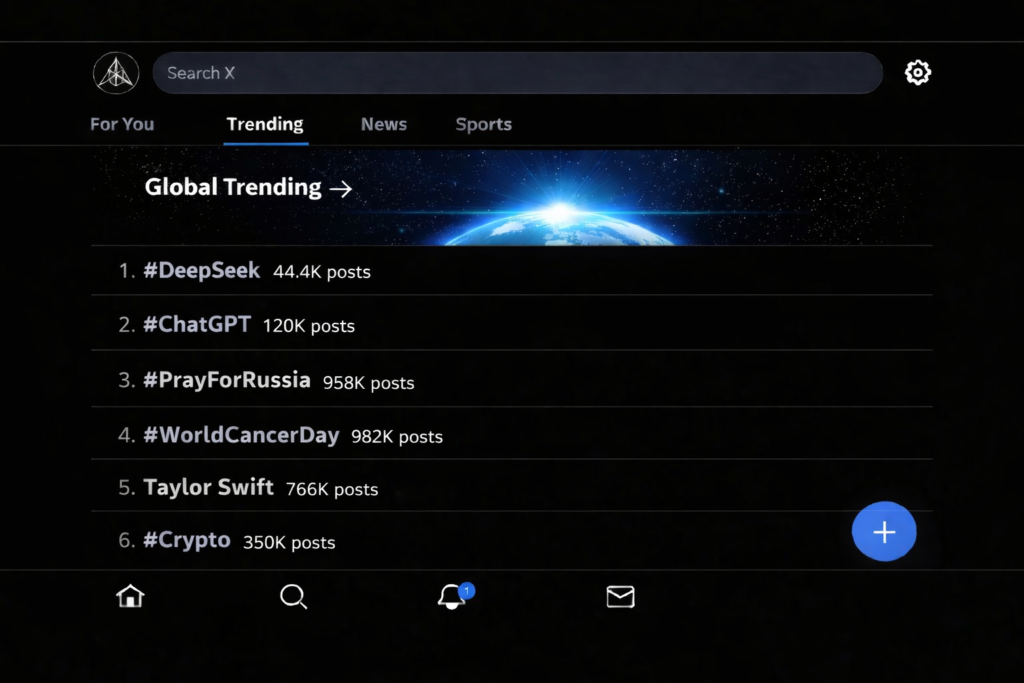
Almost overnight, discussions about DeepSeek started appearing across Silicon Valley forums, Reddit threads, GitHub issues, and X (formerly Twitter). At first, it looked like just another AI launch. But then something unusual happened. People weren’t calling it just another competitor — they started calling it a “ChatGPT Killer.”
That immediately caught my attention.
The reason behind this sudden hype is simple but powerful. For the first time, an AI model has appeared that claims to deliver GPT-4–level performance — the kind of intelligence people usually pay $20 per month for — but at a dramatically lower cost. In some cases, DeepSeek is even available openly, which is almost unheard of at this level.
This isn’t just a big deal for tech enthusiasts. It matters if you’re:
- A business owner in New York frustrated by rising AI API costs
- A developer in London searching for open-source or more flexible AI models
- Or a student anywhere in the world who wants a powerful AI tool without spending money every month
That’s exactly why this DeepSeek vs ChatGPT comparison is so important right now.
In this ultimate guide, we’re not here to blindly follow hype. We’ll break things down honestly. We’ll look at real-world performance, compare pricing models that are shaking the AI industry, and share practical insights from hands-on usage.
By the end of this article, you’ll be able to answer one big question for yourself:
Is DeepSeek really the ChatGPT killer everyone is talking about — or is ChatGPT still the smarter choice in 2026?
Let’s step into the ring.
What Is DeepSeek R1? (The New Challenger) 🕵️♂️
Before we start throwing punches in the DeepSeek vs ChatGPT comparison, it’s important to first understand what DeepSeek R1 actually is — and why so many people are suddenly paying attention to it.
DeepSeek is not a household name like OpenAI. It doesn’t have the same massive brand recognition, and it’s not backed by tech giants in the public eye the way OpenAI is supported by Microsoft. Instead, DeepSeek is a relatively new AI research company that has quietly taken a very different path to building powerful language models.
And that difference is exactly why developers are excited.
Over the past few years, OpenAI has moved further toward a closed-source approach. Models like GPT-4, GPT-4o, and o1 are extremely powerful, but no one outside OpenAI truly knows how they work internally. You can use them, but you can’t inspect them, modify them, or run them freely on your own systems.
DeepSeek chose the opposite philosophy.
DeepSeek R1 is built around an open-source mindset, which means a large part of its technology is openly available to the public. Developers can study the model, experiment with it, fine-tune it, and even deploy it on their own infrastructure. This level of transparency is rare for models that claim near GPT-4–level performance.
From my own research and testing, this is where DeepSeek feels fundamentally different. It’s not just another AI chatbot — it feels more like a serious research-backed alternative designed for people who want freedom, flexibility, and lower costs.
That’s why DeepSeek R1 is being called a true challenger. It’s not trying to beat ChatGPT by copying it. Instead, it’s challenging the entire business model behind modern AI.
And that’s what makes this DeepSeek vs ChatGPT battle so interesting.
DeepSeek’s Open-Source Approach (Why This Matters)
DeepSeek is not just offering a chatbot interface for casual conversations. What really sets it apart is that it releases the model weights of its AI systems, including DeepSeek R1.
In simple terms, model weights are the “brain” of an AI system. Having access to them means developers can run the model on their own servers, customize it, fine-tune it, and even build entirely new products on top of it.
To understand the difference:
- OpenAI lets you use ChatGPT, but you don’t get access to how it actually works internally.
- DeepSeek allows developers to take the core model itself and work with it directly.
This approach gives developers full freedom. They don’t have to pay ongoing licensing fees, depend on external APIs, or worry about sudden pricing changes. For startups, researchers, and independent developers, this is a huge advantage.
In an industry dominated by closed and expensive systems, this open approach feels like a major shift.
Why Is Everyone Suddenly Talking About DeepSeek?
The recent explosion of interest in DeepSeek is not just because it is open-source. The real reason is efficiency.
According to benchmark results and technical reports shared by researchers, DeepSeek R1 delivers performance that is surprisingly close to GPT-4 in many tasks — especially reasoning, coding, and structured problem-solving.
What makes this impressive is how DeepSeek achieved it.
Training advanced AI models usually costs tens of millions of dollars and requires massive computing resources. DeepSeek reportedly managed to train a highly capable model using far less computing power and budget compared to companies like OpenAI.
In the AI world, this matters a lot. Lower training and running costs mean:
- Cheaper API pricing
- More accessibility for developers
- Less dependence on large cloud providers
At the same time, while OpenAI has become increasingly closed about how its latest models work, DeepSeek has taken the opposite path by openly sharing its research and model details. This transparency is one of the biggest reasons developers and researchers are excited.
DeepSeek R1 doesn’t just challenge ChatGPT on performance — it challenges the entire business model of how advanced AI is built and distributed.
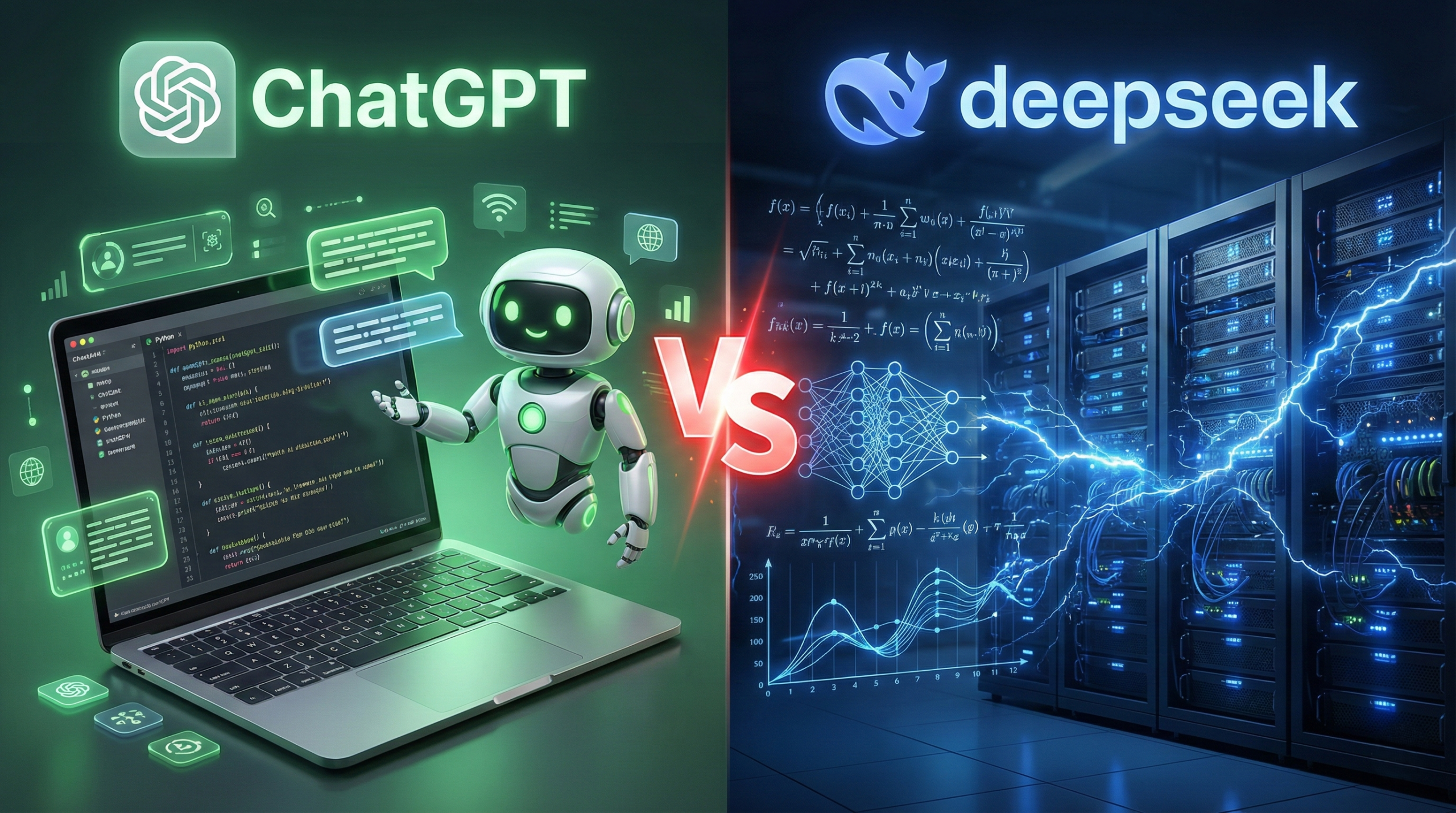
DeepSeek vs ChatGPT: The Ultimate Showdown 🥊
Now let’s come to the real question everyone cares about.
When these two tools are used side by side in real life, how do they actually perform?
Here, we’re comparing the current leader ChatGPT (especially models like GPT-4o and the reasoning model o1) with the rising challenger DeepSeek, specifically its strongest model, DeepSeek R1.
This isn’t theory. This is based on how they behave when you actually use them for daily tasks.
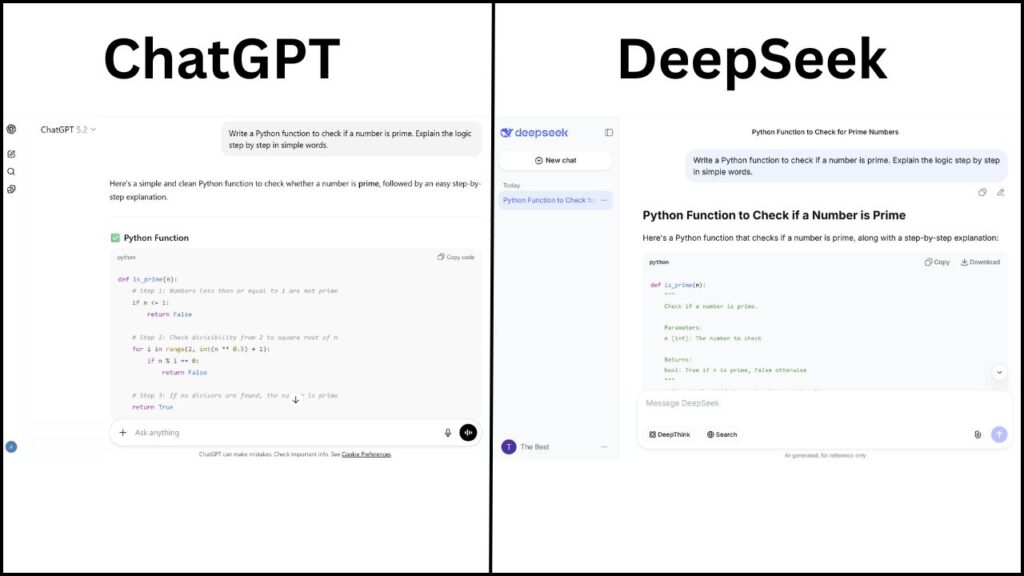
Round 1: General Conversation and Writing🗣️
For most people, AI is used for simple but important tasks — writing emails, creating blog outlines, rewriting content, or summarizing long documents like PDFs.
In this area, the experience between DeepSeek and ChatGPT feels surprisingly close.
ChatGPT:
ChatGPT still feels slightly more polished in conversation. Responses flow naturally, and it handles vague or complex prompts very well without needing much clarification. Years of user feedback clearly show here — answers feel refined and confident.
DeepSeek:
DeepSeek performs much better than most people expect. When I tested it with long-form writing prompts, the output was clear, structured, and easy to read. For example, when asked to write an essay on the Roman Empire, the content was accurate, logically organized, and didn’t feel rushed or shallow.
In fact, in blind comparisons, many users struggle to tell which response came from GPT-4 and which one came from DeepSeek for general writing tasks.
Winner:
For everyday use, it’s almost a tie. ChatGPT has a slight advantage when prompts require emotional tone or subtle nuance, but DeepSeek is close enough that most users won’t notice a big difference.
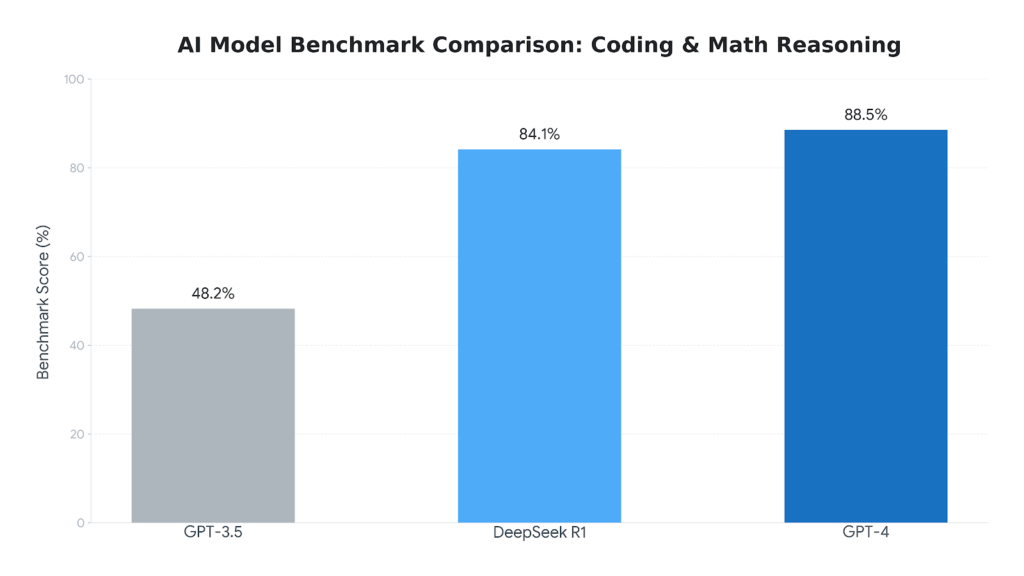
Round 2: Coding and Math Capabilities (For Developers & Students)💻
This is where the comparison gets serious — and where DeepSeek has truly surprised the community.
Developers rely on AI for writing boilerplate code, fixing bugs, understanding errors, and solving logic-heavy problems. For a long time, GPT-4 was considered the safest option for serious coding tasks.
DeepSeek R1 has changed that perception.
In coding benchmarks such as HumanEval, which are commonly used to measure programming ability, DeepSeek R1 scores very close to OpenAI’s top models. That alone made developers pay attention.
Where DeepSeek really stands out is math and logical reasoning. Instead of just giving a final answer, it often explains how it arrived there, breaking the solution into clear steps. This behavior feels similar to OpenAI’s o1 reasoning models.
For students learning math or engineers debugging logic-heavy systems, this step-by-step reasoning is extremely useful. It helps you understand the “why,” not just the result.
Winner:
DeepSeek performs exceptionally well here. For coding and math tasks, it offers performance close to GPT-4 while being far more cost-efficient, which makes it very attractive for developers.
Round 3: Up-to-Date Information and Web Browsing🌐
This is an area where the difference is very clear.
ChatGPT:
ChatGPT has built-in web browsing. If you ask about today’s stock prices, current tech news, or last night’s sports results, it can fetch fresh information from the internet in real time.
DeepSeek:
DeepSeek’s base chat interface does not yet offer the same seamless real-time web access. It mainly relies on the data it was trained on. For tasks that depend on breaking news or live updates, this can be a limitation right now.
This will likely improve in the future, but at the moment, the gap is noticeable.
Winner:
ChatGPT, without question.
The pricing battle: Is free really better? 💰
This is the part of the DeepSeek vs ChatGPT debate that has CFOs, startup founders, and developers in the United States paying very close attention.
Performance matters, yes — but pricing decides whether a tool is usable at scale or not.
To understand this properly, we need to look at pricing from two different angles:
- Everyday users who just want to use the chat interface
- Developers and businesses that rely on APIs to build real products
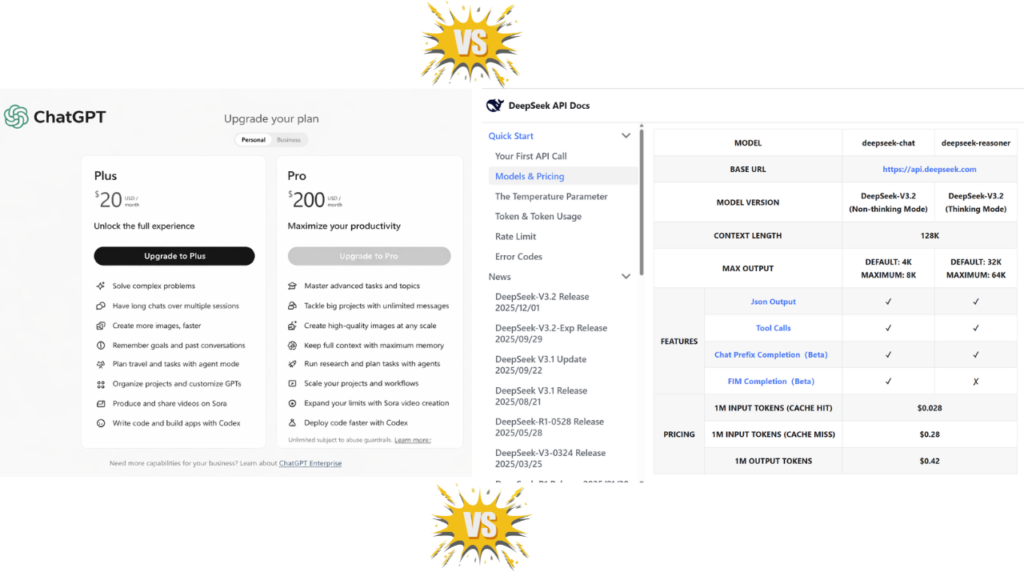
The Casual User (Chat Interface)
ChatGPT:
If you want access to OpenAI’s strongest models like GPT-4o or the reasoning model o1, you need a ChatGPT Plus subscription, which costs $20 per month.
For many professionals, this price feels justified because it saves time and boosts productivity. Millions of users are already paying for it without hesitation.
Try ChatGPT (ClickHere)
DeepSeek:
Here’s where things start to feel disruptive. As of now, DeepSeek allows users to access its top-tier chat interface completely free.
That means you’re getting AI performance that competes with a $20/month product — without paying anything.
This doesn’t mean DeepSeek will stay free forever. Paid plans will likely come later. But right now, for students, freelancers, and casual users, the value is very hard to ignore.
Reality check:
If your usage is mostly chatting, writing, studying, or coding casually, DeepSeek offers an unusually strong free option at the moment.
Try DeepSeek (ClickHere)
The Developer (Why the Industry Is Nervous)
This is where pricing stops being interesting — and starts being serious.
Developers don’t pay monthly subscriptions. They pay based on tokens, which are small chunks of text.
As a rough idea, 1,000 tokens ≈ 750 words.
OpenAI (GPT-4 level models):
OpenAI’s pricing has improved over time, but it’s still expensive at scale. Depending on the model, output tokens can cost roughly $10 to $30 per million tokens.
For small apps this is manageable, but once usage grows, costs rise very quickly.
DeepSeek (R1):
DeepSeek’s API pricing has genuinely shocked the developer community.
Reports and early usage data suggest pricing that is 10 to 20 times cheaper than comparable OpenAI models — sometimes as low as $0.50 to $1.00 per million output tokens, while still delivering strong reasoning and coding performance.
This changes everything.
What This Means in the Real World
Let’s take a realistic example.
Imagine a startup in San Francisco building an AI-powered app. With OpenAI’s API, their monthly AI costs might reach $5,000 once users scale up.
Using DeepSeek’s API instead, that same workload could cost $300 to $500.
That’s not a small optimization.
That’s the difference between:
- Efficiently managing the budget
- Scaling the app for a larger user base
- Freely experimenting with new features without cost pressure
For startups and developers, this pricing gap alone makes DeepSeek impossible to ignore.
Why Should a Global User Care? (The US Perspective)
If you’re sitting in Chicago, Los Angeles, or anywhere else in the United States, a fair question comes to mind:
“ChatGPT already works well for me. Why should I even care about DeepSeek?”
The short answer is simple — competition always benefits the user, even if you never switch tools.
For the last few years, OpenAI faced very little real pressure at the high-intelligence end of AI. If developers or businesses wanted a truly capable model, ChatGPT (especially GPT-4-level models) was often the only serious option. That lack of pressure meant prices stayed high and improvements followed OpenAI’s timeline, not the market’s.
Google’s Gemini has been improving, but DeepSeek’s aggressive entry changes the situation in a more direct way.
The growing attention around DeepSeek vs ChatGPT forces OpenAI to respond — and that response usually shows up in ways users can actually feel.
Here’s what that likely means for you:
- Lower Prices:
OpenAI may be pushed to reduce API costs to stop developers from moving to cheaper alternatives like DeepSeek. - Stronger Free Tier:
The free version of ChatGPT could start getting access to smarter models sooner, instead of keeping the best features locked behind a paywall. - Faster Innovation:
When serious competition appears, updates stop moving slowly. Features roll out faster, models improve quicker, and users benefit first.
The most important point is this:
Even if you never touch DeepSeek, its presence in the market increases pressure on OpenAI. That pressure almost always leads to better, cheaper, and more accessible AI tools for everyone — including users in the US.

The verdict: Should you switch in 2026? 🤔
So, after looking at everything — performance, pricing, usability, and real-world impact — here’s the honest conclusion of the DeepSeek vs ChatGPT debate in 2026.
There’s no one-size-fits-all answer. The right choice depends entirely on how you actually use AI.
Stick with ChatGPT (and pay the $20/month) if:
- You want the most polished and natural conversational experience, especially for nuanced writing, brainstorming, or client-facing communication.
- Real-time web browsing is a core part of your daily workflow, such as tracking news, market data, or live updates.
- You rely heavily on the broader OpenAI ecosystem — things like DALL·E 3 for images, custom GPTs, plugins, and a very stable, mature platform.
- You’re part of an enterprise or larger organization where trust, compliance, and US-based data handling policies matter more than cost savings right now.
In short, ChatGPT still feels like the safest, most complete option if reliability and ecosystem matter more than price.
Switch to DeepSeek (or use it alongside ChatGPT) if:
- You’re a developer or startup founder who wants to dramatically reduce API costs without giving up strong reasoning or coding ability.
- You’re a student, freelancer, or independent creator who wants near GPT-4–level intelligence but can’t justify a $20/month subscription.
- You work heavily with code, math, or logic and value step-by-step reasoning rather than just final answers.
- You support open-source principles and want to build on models that the wider community can study, improve, and adapt.
For many people, the smartest move in 2026 may not be choosing one over the other — but using both. ChatGPT for polished workflows and real-time needs, and DeepSeek for cost-effective, logic-heavy work.
Conclusion
Is DeepSeek a “ChatGPT Killer”?
Not completely — at least not yet.
ChatGPT is still an extremely strong, polished, and widely adopted product. Features like real-time browsing, a mature ecosystem, and deep enterprise adoption give it an advantage that DeepSeek hasn’t fully matched so far.
That said, DeepSeek cannot be ignored.
What DeepSeek has done is send a very clear message to the entire AI industry. It has shown that high-level AI intelligence doesn’t have to sit behind expensive subscriptions or require massive budgets to build and run. That alone changes the conversation.
For the first time in a long while, ChatGPT isn’t just facing another feature-based competitor. It’s facing a challenger that questions the underlying economics and philosophy of how powerful AI should be developed and shared.
And in that kind of competition, there’s one clear winner: the users.
More choice, lower costs, faster innovation — that’s what this shift brings. Whether DeepSeek fully replaces ChatGPT or not, its impact is already being felt.
If you’re interested in how AI is transforming content creation beyond chatbots, you’ll love this detailed guide on video localization.
We recently explored [How to Translate Video to Any Language? 5 Best Free AI Video Translator Tools with Lip-Sync (2026 Guide)], where we break down tools that can translate videos into multiple languages while keeping lip-sync natural and realistic.
This is especially useful for creators, marketers, and businesses looking to reach a global audience without re-recording videos.
Frequently Asked Questions (FAQ)
Q1. What is the main difference between DeepSeek and ChatGPT?
The biggest difference in the DeepSeek vs ChatGPT comparison is their approach. ChatGPT focuses on a polished, all-in-one ecosystem with features like browsing and plugins, while DeepSeek focuses on efficiency, lower costs, and open access to its models.
Q2. Is DeepSeek really free to use?
Yes, at the moment DeepSeek offers free access to its main chat interface. This is one of the reasons the DeepSeek vs ChatGPT debate has gained so much attention. However, like most platforms, pricing models may change in the future.
Q3. Can DeepSeek fully replace ChatGPT in 2026?
Not completely. ChatGPT still has advantages in real-time web browsing, ecosystem tools, and enterprise adoption. That said, for coding, logic, and cost-sensitive use cases, DeepSeek can already act as a strong alternative in the DeepSeek vs ChatGPT comparison.
Q4. Which is better for students: DeepSeek or ChatGPT?
For students who cannot afford a $20/month subscription, DeepSeek is a very attractive option. In the DeepSeek vs ChatGPT discussion, DeepSeek stands out by offering strong reasoning and writing capabilities at no cost.
Q5. Is DeepSeek safe to use?
DeepSeek is being actively used by developers and researchers worldwide. Like with any AI tool, users should avoid sharing sensitive or private information. Safety and compliance standards may vary compared to ChatGPT, especially for enterprise use.
Q6. Which tool is better for coding and math?
In many coding and math tasks, DeepSeek performs extremely well and often explains its reasoning step by step. In the DeepSeek vs ChatGPT comparison, this makes DeepSeek especially useful for developers, engineers, and students.
Q7. Does ChatGPT still have advantages over DeepSeek?
Yes. ChatGPT still leads in areas like real-time web access, integration with tools like DALL·E, and a mature ecosystem. These advantages keep ChatGPT relevant despite growing competition in the DeepSeek vs ChatGPT space.
Q8. Should I use DeepSeek or ChatGPT?
The best choice depends on your needs. Many users in 2026 are using both — ChatGPT for polished workflows and live information, and DeepSeek for cost-efficient reasoning and coding. That balance often makes the most sense in the DeepSeek vs ChatGPT debate.
Q9. Is DeepSeek open-source?
DeepSeek has released model weights for some of its models, allowing developers to run and customize them. This open approach is a key reason why the DeepSeek vs ChatGPT conversation is so important in the AI community.
Q10. Will DeepSeek force ChatGPT to become cheaper?
Possibly. Strong competition often leads to lower prices and better free tiers. The growing DeepSeek vs ChatGPT rivalry could benefit users through more affordable and powerful AI tools.